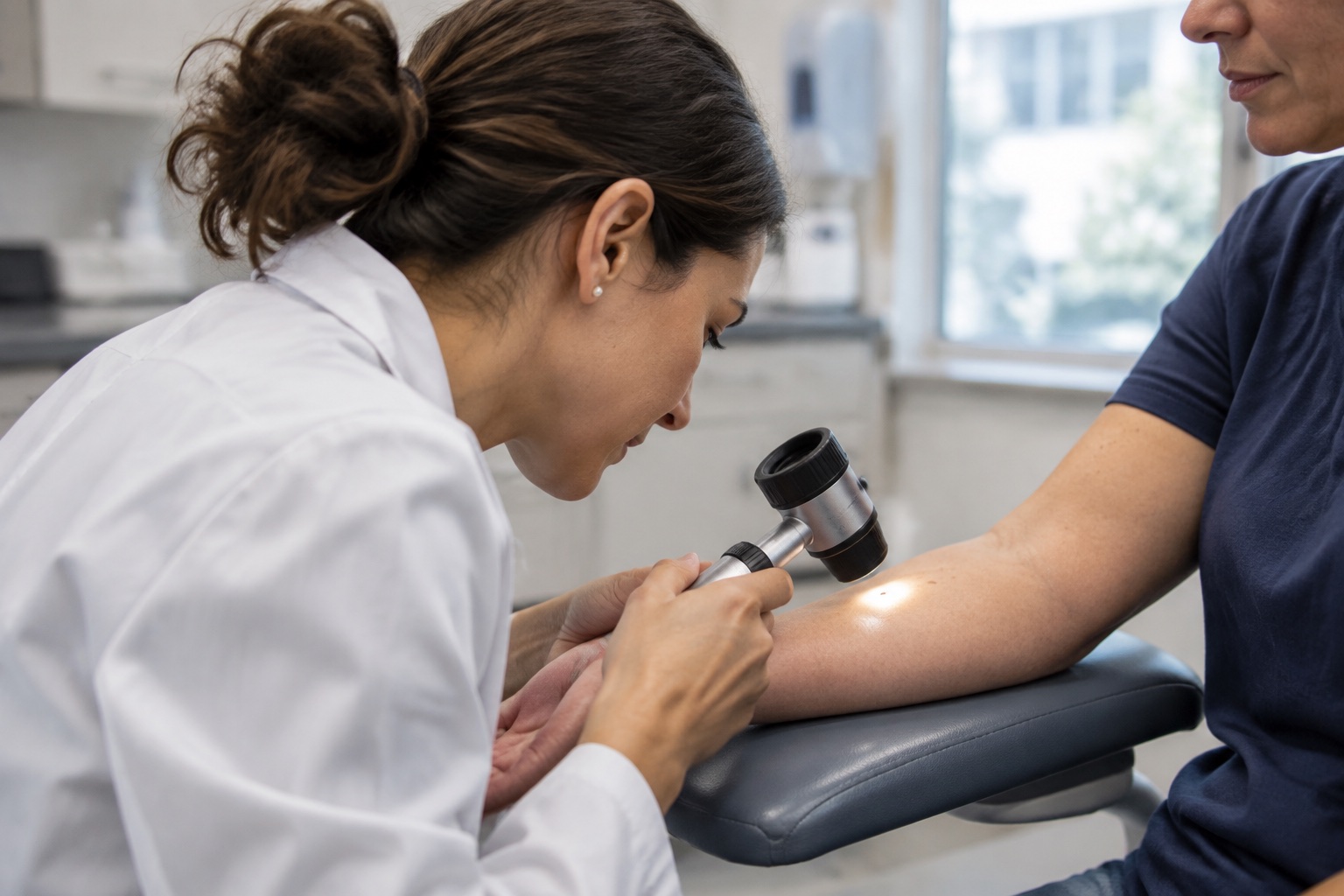
1. What Changed Between the 1987 NIH Rules and the 2021 Revision
Under the 1987 rules, young children with six café-au-lait macules often spent years in diagnostic limbo waiting for second signs such as Lisch nodules or neurofibromas to appear. By incorporating near-infrared OCT choroidal abnormalities and high-sensitivity NF1 sequencing (Legius et al., 2021), clinicians can establish or exclude NF1 accurately in infancy or early childhood without unnecessary brain anesthesia scans.
2. How Café-au-Lait Spots Are Counted — and What Does Not Count
Accurate dermatologic measurement prevents false referrals. Typical NF1 café-au-lait macules exhibit uniform light-to-medium brown pigmentation with smooth, well-demarcated ("coast of California") borders:
- Pre-pubertal cutoff (>5 mm): At least six distinct macules measuring more than 5 millimeters across their longest axis under normal room illumination (Wood's lamp ultraviolet enhancement does not substitute for visible room-light counting).
- Post-pubertal cutoff (>15 mm): At least six macules exceeding 15 millimeters in greatest diameter.
- Lesions with irregular jagged borders ("coast of Maine"): Large segmental or jagged pigment patches warrant consideration of McCune-Albright syndrome or mosaic NF1 rather than classic constitutional NF1.
3. Separating NF1 from Legius Syndrome (SPRED1) and Constitutional MMR Deficiency
Roughly 2% to 8% of sporadic patients presenting solely with multiple café-au-lait macules and axillary/inguinal freckling carry a pathogenic variant in SPRED1 (chromosome 15q14), causing Legius syndrome. Distinguishing the two conditions transforms family counseling:
| Feature | Neurofibromatosis Type 1 (NF1) | Legius Syndrome (SPRED1) |
|---|---|---|
| Café-au-lait macules & freckling | Present in >95% of patients by age 5 | Present; clinically indistinguishable on skin exam |
| Cutaneous or plexiform neurofibromas | Common (plexiforms in 30%–50%) | Absent (lipomas may occur in adults) |
| Optic pathway gliomas & Lisch nodules | OPG in 15%–20%; Lisch/choroidal spots in >70% | Absent (spares annual OPG eye surveillance) |
| Malignant nerve-sheath risk (MPNST) | 8%–13% lifetime risk | Not associated with neurogenic malignancy |
In rare children with café-au-lait macules accompanied by consanguinity, hematologic malignancies, or high-grade brain tumors, multigene RASopathy panels should also exclude Constitutional Mismatch Repair Deficiency (CMMRD) (biallelic variants in MLH1, MSH2, MSH6, or PMS2).
Frequently Asked Clinical Questions
How many cafe-au-lait spots meet the 2021 NF1 criterion in a toddler?
Six or more smooth-bordered cafe-au-lait macules measuring greater than 5 millimeters across their longest axis in pre-pubertal individuals, or greater than 15 millimeters after puberty.
Why do doctors order both NF1 and SPRED1 genetic testing together?
Children who only have cafe-au-lait macules and skinfold freckling without tumors or eye findings may have Legius syndrome (SPRED1), which carries zero risk of neurofibromas or optic pathway gliomas.
Key Consensus Guidelines & Primary Sources
- Legius E, Messiaen L, Wolkenstein P, et al. Revised diagnostic criteria for neurofibromatosis type 1 and Legius syndrome: an international consensus recommendation. Genetics in Medicine. 2021;23(8):1506–1513. PubMed 34012067.
- Plotkin SR, Messiaen L, Legius E, et al. Updated diagnostic criteria and nomenclature for neurofibromatosis type 2 and schwannomatosis: an international consensus recommendation. Genetics in Medicine. 2022;24(9):1967–1977. PubMed 35674741.
- Gross AM, Wolters PL, Dombi E, et al. Selumetinib in children with inoperable plexiform neurofibromas (SPRINT Phase II). New England Journal of Medicine. 2020;382(15):1430–1442. PubMed 32187457.
- Moertel CL, Hirbe AC, Shuhaiber HH, et al. ReNeu: A pivotal phase IIb trial of mirdametinib in adults and children with symptomatic neurofibromatosis type 1-associated plexiform neurofibroma. Journal of Clinical Oncology. 2025;43(7):758–769. PubMed 39514828.
- Miller DT, Freedenberg D, Schorry E, et al. Health supervision for children with neurofibromatosis type 1 (American Academy of Pediatrics). Pediatrics. 2019;143(5):e20190660. PubMed 30988031.